Water Heater Expansion Tank in Colorado Springs
Expansion tank on a Colorado Springs water heater: what it does, what size a 40 or 50 gallon unit needs, when it is required, and why the T&P drips.
One Colorado Springs number, water heaters only.
A relief valve that drips after the heater has run and then stops is the classic expansion signature. A valve that runs continuously is a different fault. The timing is the diagnosis, and it decides whether the answer is one small part or a call about something else.
An expansion tank absorbs the water that expands as a tank of cold water comes up to temperature. This page covers what it does, what size a 40 or 50 gallon unit takes, when the local authority requires one, and how to tell a failed tank from a failed valve. The hub routes the other problem pages.
What it does
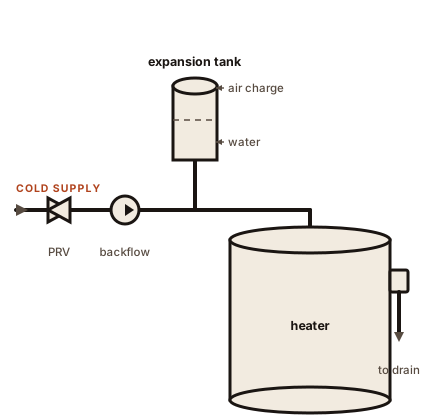
Water expands when it heats, and it does not compress. In an open system the extra volume pushes back into the municipal supply. In a closed system it cannot, because a backflow preventer, a check valve or a pressure-reducing valve stands in the way.
The pressure then has one place to go: the relief valve. That is why a closed system without a working tank shows up as a weeping valve rather than an obvious failure. The tank gives the expanding water somewhere to sit, behind a bladder with an air charge, so the pressure stays where it belongs.
What size
The tank has to suit the volume of water in the system and the pressure on the supply, so the manufacturer’s chart for the specific tank is the final word. The common residential pairings are these:
| Water heater | Typical expansion tank | Pre-charge |
|---|---|---|
| 40 gallon | 2 gallon | Set to the house pressure |
| 50 gallon | 2 to 4.5 gallon | Set to the house pressure |
The pre-charge is where installations fail quietly. A new tank often arrives charged to a factory figure that does not match the house, and a tank charged too low does part of its job and then stops. Measure the static pressure at a hose bib and set the tank to it before it is connected.
Is it required?
The local authority answers this rather than a supplier. The Pikes Peak Regional Building Department’s handout, Water Heater Replacements and Installation, states at item 12 that an expansion tank or expansion device is required when a pressure-reducing valve, check valve or backflow preventer is on the supply. The sheet is dated 03/04/24.
A closed system needs one to pass inspection. An open system with no backflow device and no pressure-reducing valve may genuinely not need one, and saying so is the honest answer.
Signs it has failed
- The relief valve weeps after a heating cycle and stops. The expansion signature. The tank is not absorbing the swing, or the system never had one.
- Water comes out of the air valve. The bladder has failed and the tank is full of water, so it is doing nothing except adding weight.
- The tank is heavy and waterlogged. Same failure, found by hand rather than by valve.
- Pressure spikes at a hose bib after the heater runs. A gauge on a bib will show it.
A closed system without a working tank pushes the problem onto the relief valve, and repeated discharge is how a cheap failed part becomes a water-damage job. The leaking page covers what to do when water is already on the floor.
Call (719) 435-8785 and say when the valve drips. After a heating cycle, and only then, is a different answer from all the time.
Replacement versus a first installation
Two jobs that look alike and are not.
A replacement swaps a failed tank for one of the same size: isolate, depressurise, unscrew, match the thread and the charge. The trap is matching the old size rather than the system.
A first installation adds a tank to a system that never had one. That starts with a question: what closed the system, and is the tank sized for the pressure actually there. It can also need a bracket, a tee and space a closet may not have.
What moves the figure
This site publishes no prices. What changes the scope is the tank size, whether the job is a replacement or a first installation, the space for the tank, whether the relief valve is replaced at the same time, and whether a pressure-reducing valve or backflow device has to be added. A first installation with no room for a tank is a different job from a straight swap.
Questions people ask
What is the purpose of an expansion tank?
It gives expanding water somewhere to go on a closed system, so pressure stays below the relief valve setting instead of being relieved through it.
How big of an expansion tank for a 50 gallon water heater?
Two to four and a half gallons is the usual residential range, with the exact figure from the tank manufacturer’s chart for the system volume and supply pressure. The pre-charge matters as much as the size.
How often do you change an expansion tank?
When it fails, not on a clock. A tank that passes water through its air valve, feels heavy, or stops holding pressure after a heating cycle is finished. Checked yearly with the relief valve test, it usually announces itself.
Why does my water heater not have an expansion tank?
Older installations predate the requirement, and an open system with no backflow preventer or pressure-reducing valve may not need one.
Is a hot water tank under pressure?
Yes, and that is normal. A tank runs at the supply pressure plus whatever the heating cycle adds. The expansion tank exists to keep the second part of that from reaching the relief valve.
If the valve drips after a heating cycle, or the tank feels heavy, describe it on (719) 435-8785. The maintenance page covers the yearly relief valve test and the tank check that catches this early.