Water Heater Leaking in Colorado Springs
Water heater leaking in Colorado Springs? Where it leaks tells you what failed - T&P valve, drain valve, seam or fitting - and when it means a new tank.
One Colorado Springs number, water heaters only.
Turn the water off first. Close the cold supply valve on top of the tank, then cut the power at the breaker or set the gas control to off. Do that before you read further or call anyone.
Where the water appears tells you what failed, and that decides whether this is a fitting or a tank.
Before anything else, shut it off
- Close the cold inlet valve on top of the tank. If it will not close, close the main valve where the supply enters the house.
- Electric: switch the breaker off. Gas: turn the control valve to off or pilot.
- Do not touch a wet junction box or element cover, and do not reset the breaker into a wet unit.
- If you smell gas, stop and leave. Call the gas utility from outside.
Where the water is coming from
Find the highest point where water appears. Water runs down, so the wet spot is often below the failure.
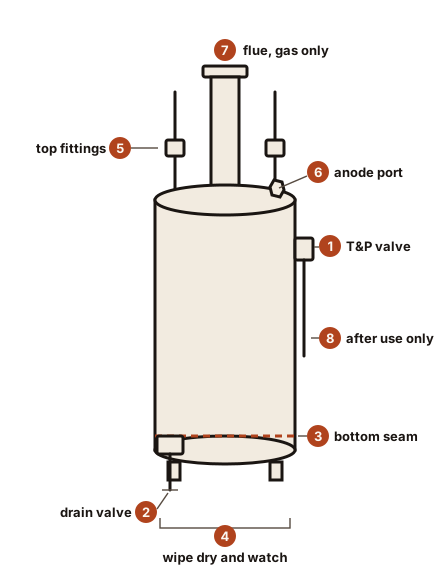
1. The T&P valve
The relief valve on the side or top, with a discharge pipe. Water here means pressure or temperature, not a cracked tank: thermal expansion in a closed system, or a valve that no longer seats. A drip during a heating cycle that stops afterwards is expansion. A continuous run is a valve or pressure fault. The expansion tank page covers the first case.
2. The drain valve
The spigot at the bottom where a hose connects. A worn washer, sediment in the seat, or a valve left partly open after a flush. Usually repairable. A valve that will not reseat is how a maintenance job becomes a replacement.
3. The bottom seam
Where the shell meets its base. Rust here is the shell failing, and no repair fixes a rusted shell. Patching the outside buys weeks. This is the replacement case.
4. The bottom left specifically
Only two candidates: the drain valve, or the seam behind it. Wipe it dry and watch where the water returns. At the spout or the threads it is the valve; along the seam above the base it is the tank.
5. The top fittings
Inlet and outlet nipples, dielectric unions, flex connectors. Water at the top is usually a fitting or a seal, and those are repairable.
6. The anode port
The hex plug on top where the anode screws in. A slow weep here often starts after service, or when corrosion reaches the port. Repairable.
7. The flue area, on gas
Water around the vent connector is often condensation from a venting problem rather than a tank leak. Look for staining on the connector. A venting fault needs attention before it becomes a carbon monoxide problem.
8. After a shower or heavy use
Water that appears after hot water use and stops later is thermal expansion. A closed system with no working expansion tank pushes it out through the T&P valve. That is pressure, not the tank.
Is it dangerous?
A leak near the gas control, the burner compartment or the electrical connections should not wait. Neither should water spreading toward a finished room, or appearing at a ceiling below the unit.
- Gas smell: leave and call the utility. Do not test anything.
- Water at the electrics: leave the breaker off.
- Water through a floor or ceiling: the damage climbs faster than the repair bill.
Most leaks are a same-week problem. Water at the gas valve, the electrical side, or through a ceiling is a same-hour problem.
If you cannot tell which location you are looking at, call (719) 435-8785 and describe it. Where the water appears and when is usually enough to tell a fitting from a tank.
Repair or replace?
The tank shell is not repairable. Everything around it is: valves, fittings, nipples, connectors, the anode port, the T&P valve.
Water from the shell means a new tank. Water from anything attached to it is usually a repair. If the diagnosis is the shell, the repair conversation is over, and the replacement page covers what that job involves. The hub routes the other problem pages.
Most homes in the sampled ZIPs are owner-occupied, 73% to 88% (ACS 2024 five-year, six-ZIP ring sample), so this is usually the owner’s decision rather than a landlord’s.
What changes the size of the repair
A repair’s size depends on the part and the access. These are the things that change it.
- Which part failed. A drain valve washer is small. A corroded nipple behind the tank is not.
- Whether the unit has to be drained before the part can be reached.
- Access. A closet or a crawlspace takes longer than a garage.
- Whether the valve and the tank are separate faults.
- Whether the shell has failed, in which case there is no repair to do.
Questions we get asked
What should I do if my water heater is leaking?
Shut the cold supply valve, then cut the power or gas. Contain the water and find the highest point where it appears. The location decides whether it is a part or the tank.
Is a leaking water heater dangerous?
It can be. Water at the gas control or the electrical connections is the serious case, and a gas smell means leaving. A slow drip at a fitting is mostly a damage problem.
Why do water heaters crack?
The shell rusts from the inside, and the anode rod is what slows that down. Once the rod is consumed, the seam at the base is usually where it gives first.
What does it mean if water is in the pan under the heater?
The pan caught it, which means the leak is small enough to contain. It does not say where the water came from. Check the T&P discharge, the drain valve and the base seam.
How much does a leak repair cost?
The part decides most of it, along with whether the tank must be drained and how hard it is to reach. If the shell has failed, there is no repair to do.
Call (719) 435-8785 and describe where the water is and when it appears. That is usually enough to tell you whether this is a valve, a fitting or a tank before anyone arrives.