Water Heater Maintenance and Flush in Colorado Springs
Water heater maintenance in Colorado Springs: flush, anode, T&P valve and expansion tank, how often each is due, and what to skip.
One Colorado Springs number, water heaters only.
Four things decide how long a water heater lasts: sediment removed by a flush, an anode rod that has not been consumed, a relief valve that still opens, and an expansion tank that still holds its charge. The intervals differ, and one of them is worth skipping when the tank is already failing.
Most homes in the sampled ZIPs are owner-occupied, 73% to 88% (ACS 2024 five-year, six-ZIP ring sample), so the person deciding this is usually the owner. The hub routes the other problem pages.
The four things that extend life
- The flush. Sediment settles on the tank floor, insulates the water from the heat, and eats capacity. Draining the tank clears it. Popping and rumbling are the noise it makes when heated through.
- The anode rod. A sacrificial rod that corrodes in place of the tank lining. It decides how long the steel lasts, and it is consumed silently.
- The T&P valve. The safety device on the tank. It is meant to open under excess pressure or temperature and close again. Lifting the lever once a year proves it still will.
- The expansion tank. On a closed system, it absorbs the water that expands as it heats. Without its charge, the pressure has nowhere to go and the relief valve starts weeping.
How often, honestly
| Part | Usual interval | What changes it |
|---|---|---|
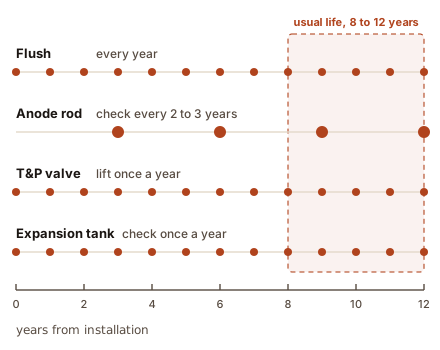
| Flush | Annually | What drains out. Clear water argues for less often; gritty water for more |
| Anode rod | Checked every two to three years | How much rod is left, and whether there is clearance to pull it |
| T&P valve | Lifted once a year | Whether it reseats |
| Expansion tank | Checked yearly | Whether the system is closed and the relief valve is weeping |
The water tells you: a tank that drains clear in a few gallons needs less than one that runs grey for twenty minutes. Look at what comes out before deciding.
Call (719) 435-8785 if the relief valve has started to weep or the drain will not close. Those are the cases where waiting makes the job bigger.
When maintenance is the wrong spend
- The tank is leaking at the shell or the base. A flush does not fix a failed shell and can make the leak worse. That is a replacement conversation.
- The unit is past its service life and the anode is gone. Eight to twelve years is a general expectation. Spending on a tank that is already rusting inside is money into a tank that is leaving.
- The drain valve is already stiff. A valve that has not been opened in years can fail to reseat, which turns a maintenance job into a leak.
Saying no to a flush that is not needed is part of the service.
Flushing it yourself
Reasonable for an owner, with two ways to get it wrong.
- Turn the unit off. Gas: control to off and let it cool. Electric: breaker off. Never drain a tank with the power on.
- Run a hose from the drain valve somewhere that can take hot water.
- Open the valve until the water clears, then close it.
- Refill before restoring power, and check the valve and the base for weeping.
Sediment can block the valve on the way out, and an old valve can fail to reseat on the way back. Either one turns a free job into a call. Stop if the valve will not close or water appears at the base.
The anode rod
The rod corrodes so the lining does not. It is the cheapest thing here and the one that decides the tank’s life, which makes it worth checking on an unknown unit.
The catch is access. The rod is long, it comes out of the top, and a unit in a closet with six inches of clearance cannot give it up without moving the unit or opening the ceiling. That is a job to price before it starts.
The not heating page owns the part and states the scope note plainly: the anode decides lifespan, not heat.
The T&P valve and the expansion tank
Lift the relief valve lever once a year and let it snap back. Water should run and stop. A valve that weeps afterwards, or one that will not open, is a part to replace rather than a tank.
A valve that discharges is usually a pressure story. On a closed system the cause is often the expansion tank, and the expansion tank page covers the mechanism and the check.
Questions people ask
How often should you flush a hot water heater?
Annually is the starting point, and the water decides from there.
How much does a plumber charge to flush a hot water heater?
This site publishes no prices. What moves the figure is tank size, access, whether the drain valve cooperates and whether the anode can be reached.
What is the most common problem with gas water heaters?
A pilot or igniter that will not hold, and a thermocouple or thermopile that has weakened. Sediment is the most common problem on either fuel, and the one maintenance addresses.
What is the average lifespan of a water heater?
Eight to twelve years is a general expectation, not a promise. A tank with a changed anode and clean water lasts longer.
How often do you service a hot water heater?
Once a year for the flush and the relief valve test, every two to three years for the anode, yearly for the expansion tank. Doing all four on a healthy tank is fine; on a leaking tank it is not maintenance.
If the unit is noisy, the water is not as hot as it was, or the relief valve has started to weep, describe it on (719) 435-8785 and you will be told which of the four is worth doing.