Water Heater Not Heating in Colorado Springs
Water heater not heating in Colorado Springs? Which part failed - element, thermostat, thermocouple, breaker or dip tube - and what to check first.
One Colorado Springs number, water heaters only.
Electric and gas units fail differently, so start with the fuel. On electric, the order is breaker, the reset button on the upper thermostat, the heating element, then the thermostat. On gas, it is pilot or igniter, thermocouple or thermopile, then the gas control valve. If the unit runs but the water is only warm rather than hot, the causes are different, with their own section below. If you smell gas at any point, leave the house and call the utility before reading on.
The parts are named on purpose: a diagnosis you can follow is also one you can check a quote against. The hub routes the other problem pages.
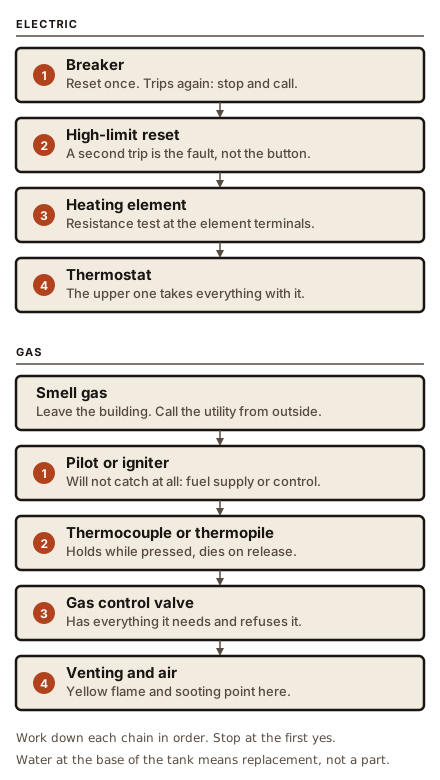
Electric: four things, in order
If the unit has power but no heat, skip to the reset button. Pressing it costs nothing.
- The breaker. A unit that lost a leg of its supply can light its controls and do nothing else. Check it at the panel, not by whether the unit looks alive.
- The reset button, the high-limit cut-out. On most residential units it sits on the upper thermostat, behind the side access panel. Press it once. One reset is fine; a second trip is a fault, and the fault is behind the button, not the button. It is the cheapest fix that exists.
- The heating element. Two per tank, usually. A failed element leaves hot water that runs out in minutes, warm water only, or no heat at all with everything appearing powered. Confirming which one has failed is a resistance test at the element terminals, and that is technician work.
- The thermostat. The upper one controls the whole sequence, so its failure takes everything with it. A lower-only failure looks different: the first shower of the day is hot and the last is not. Both are routine replacements on a sound tank.
If the testing stops at the breaker and the reset, the repair page explains which repairs are worth pricing.
Gas: four things, in order
If you smell gas, do not test anything, do not switch anything on, and leave the house. Call the gas utility from outside. Everything below can wait; that cannot.
- Pilot or igniter. Is the pilot out? Does the igniter click and hold when you turn a hot tap on? A pilot that will not catch at all points at fuel supply or the control, not at heat.
- The thermocouple or thermopile. The rod beside the pilot proves the flame to the control. When it weakens, the classic symptom is a pilot that holds while you press and dies when you let go. Replacement is a small, common repair.
- The gas control valve. When it fails, the unit has everything it needs and refuses it. A bigger part than the thermocouple and a bigger job, but still a part.
- Venting and air supply. Last, because it is rarer. A burner starved of air struggles or cuts out, and a restricted flue is a safety question before it is a comfort one. Yellow flame and sooting point this way.
Gas work beyond the pilot and the thermocouple is not a do-it-yourself question. State what the unit is doing and the part is usually named before a van moves.
Running, but the water is only warm
A unit that heats but never quite gets there is its own family of faults, and it overlaps with no heat at all far less than people expect.
- A dip tube breaking up. The tube delivers cold to the bottom of the tank; when it breaks up, cold mixes into hot at the outlet and showers shorten.
- Sediment on the tank floor. It insulates the water from the heat and eats capacity. It is also the popping and the rumbling.
- A failing lower element (electric). Hot early, thin later is the tell. The upper carries the whole load, which is why the water still reaches hot.
- Crossed connections after other plumbing work. Hot and cold mixed behind walls, typically after someone was in the house doing other work.
- A thermostatic mixing valve. Deliberately installed, and set wrong means warm. Know it is there before blaming the tank.
No heat at all is the two checklists above; the no hot water page takes the whole-house version.
Two sentences usually settle this call: what the unit is doing, and roughly how old it is. Call (719) 435-8785 and you will be told which side it is on.
The part that is not a heating fault: the anode rod
A scope note, plainly stated: the anode rod sits on this page because it decides how long a tank lasts, not whether the water heats. It is a rod inside the tank that corrodes in place of the lining and is consumed over years of service; once it is gone, the tank rusts from the inside, and the rust-coloured water and the seam leak are a matter of time rather than chance. Nothing about it stops a burner or an element from heating.
Changing it on a sound tank is inexpensive and worthwhile. The maintenance page carries the inspection cadence and the flush.
When to stop and call
- You smell gas, anywhere in the process.
- There is scorching, a burnt smell or discoloured wiring at the unit or the junction box.
- The breaker trips a second time after it has been reset.
- Water is pooling at the base of the tank, or the tank is wet along its seam.
- The repair quoted now exceeds half the installed cost of a new unit.
The breaker and the reset are yours to operate; 240-volt wiring and gas piping are not. Owner occupancy in the ZIPs sampled for this market runs 73% to 88% (ACS 2024 five-year, six-ZIP ring sample), so the person reading this is usually the owner.
Questions people ask before a diagnosis call
Why is my water heater running but not heating?
Heating and delivery are separate problems. Warm water out of a running unit is the warm-water section above; nothing hot at all is the checklists. The unit’s age tips which is more likely.
Why does my hot water seem to be running out faster?
On electric, usually a failing lower element, with the upper carrying the load alone. Otherwise a dip tube that has broken up, or sediment taking usable capacity from the tank.
What is the average lifespan of a water heater?
About eight to twelve years as a general expectation, longer with a changed anode and clean water. A dry, reliable tank is not a replacement waiting to happen; a younger unit leaking at the base is gone sooner than its age suggests.
How often should I flush my water heater?
It depends on what the water carries. A drain that runs clear in a few gallons flushes annually and forgets it; one that runs cloudy and gritty for twenty minutes is telling something. The maintenance page carries the working answer.
Why did my water heater stop working all of a sudden?
A tripped breaker on electric, or a pilot out on gas, is the fastest to check. An element or thermocouple failing under load is the common sudden part failure. Water reaching the electrics is the serious one: a wet base with a dead unit is an emergency call, not a diagnosis exercise.
Call (719) 435-8785 and describe the unit and the symptom. Name the part you suspect first, and the diagnosis will either confirm it or replace it before anyone quotes anything.